Large language models can write code that passes tests. But does that code run efficiently? Is it maintainable? Current benchmarks can’t answer these questions because they only measure correctness. COMPASS changes that by evaluating AI-generated code across three dimensions: whether it works, whether it scales, and whether it’s well‑written.
현재 코드 생성 벤치마크의 문제점은?
Most AI code generation benchmarks, including HumanEval, MBPP, and HackerRank‑ASTRA, evaluate models on a single criterion: functional correctness. If the code passes the test cases, it scores well.
This creates two blind spots:
Efficiency is ignored. A brute‑force O(n³) solution scores the same as an optimal O(n log n) algorithm, provided both produce correct output. In production, that distinction is the difference between software that scales and software that crashes under load.
Quality is invisible. Code that’s difficult to read, maintain, or extend receives no penalty. Nested complexity, poor naming, and lack of modularity go unmeasured, even though these factors directly impact long‑term engineering productivity.
COMPASS는 어떻게 작동하나요?
COMPASS (COdility’s Multi‑dimensional Programming ASSessment), developed by Ph.D.–level assessment scientists, evaluates code‑generation models across three independent dimensions:
- Correctness – Does the code produce the right output? Scored as the percentage of test cases passed, including edge and corner cases.
- Efficiency – Does the code scale? Tested against large inputs near the upper constraint bounds, with strict runtime thresholds derived from expert reference solutions.
- Quality – Is the code maintainable? Analyzed using CodeScene for complexity, readability, modularity, and adherence to best practices. Scored 1–100.
The benchmark consists of 50 competitive‑programming problems from real Codility competitions held between 2011 and 2021, with 393,150 human submissions providing empirical baselines.
연구 결과는?
We evaluated three leading reasoning‑enhanced models: Anthropic Claude Opus 4, Google Gemini 2.5 Pro, and OpenAI O4‑Mini‑High.
Key finding: Models that excel at correctness don’t necessarily produce efficient or maintainable code.
Table VI – Overall model performance scores (median / mean ± SD for each model on the COMPASS metrics)
| 모델 | 정확도 | 효율성 | 품질 | 종합점수 |
|---|---|---|---|---|
| Claude‑Opus‑4 | 100 / 72.2 ± 36.5 | 22.2 / 35.4 ± 39.1 | 93.8 / 92.3 ± 6.2 | 66.7 / 66.1 ± 23.8 |
| Gemini‑2.5‑Pro | 100 / 93.8 ± 20.3 | 100 / 85.4 ± 30.3 | 94.5 / 93.2 ± 5.9 | 97.9 / 90.4 ± 17.1 |
| O4‑Mini‑High | 100 / 95.6 ± 17.4 | 100 / 93.0 ± 21.5 | 93.7 / 89.2 ± 12.9 | 97.5 / 92.3 ± 15.5 |
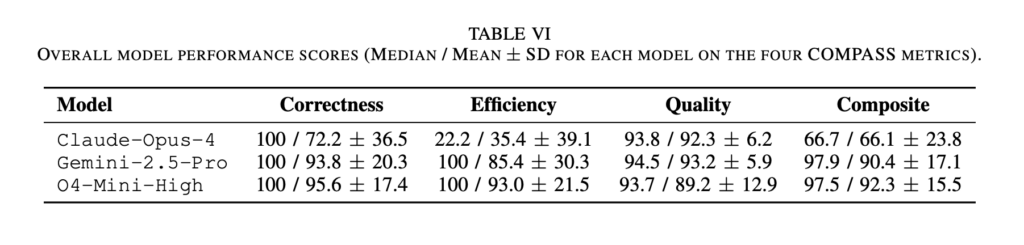
Claude Opus 4 achieved high code‑quality scores but struggled significantly with efficiency, producing solutions that frequently timed out on large inputs. O4‑Mini‑High demonstrated both the highest average performance and the most consistent results across repeated runs.
Statistical analysis confirmed that the three dimensions capture genuinely different aspects of model capability. Code quality, in particular, was found to be largely independent of both correctness (r = 0.089) and efficiency (r = 0.022).
엔지니어링 팀에 왜 중요한가?
If you’re using AI tools for code generation, or evaluating which models to adopt, correctness‑only benchmarks give you an incomplete picture.
A model that scores 95 % on HumanEval might produce:
- Production‑scale data에서 타임아웃되는 코드
- 디버깅이 어려운 깊게 중첩된 함수
- 동작은 하지만 기술 부채를 증가시키는 솔루션
COMPASS helps you understand these trade‑offs before they appear in your codebase.
COMPASS의 향후 계획은?
This initial release focuses on Python solutions to algorithmic problems. Future development will expand to additional programming languages, more realistic multi‑file project scenarios, and a wider range of models including open‑source alternatives.
The full research paper, including detailed methodology, per‑task breakdowns, and appendices with all 50 problem baselines, is available for download.
👉 Download the full COMPASS research paper (PDF)
For questions about the methodology or partnership enquiries, contact [email protected].

Bartosz Michalski – Codility
COMPASS란?
COMPASS (Codility’s Multi‑dimensional Programming ASSessment)는 정확도, 효율성, 품질 세 가지 차원에서 AI 코드 생성 성능을 평가하는 벤치마크입니다. 50개의 경쟁 프로그래밍 문제와 393,150개의 인간 제출물을 기준선으로 사용합니다.
다른 벤치마크와의 차이점은?
HumanEval, MBPP 등 대부분의 벤치마크는 코드가 테스트를 통과했는지만 측정합니다. COMPASS는 코드가 작동하는지뿐만 아니라, 대규모 입력에서도 성능이 유지되는지, 그리고 유지보수가 쉬운 구조인지까지 평가합니다.
평가된 모델은?
Anthropic Claude Opus 4, Google Gemini 2.5 Pro, OpenAI O4‑Mini‑High 세 모델을 테스트했습니다.
가장 좋은 모델은?
O4‑Mini‑High가 종합점수 92.3 %로 가장 높았고, Gemini 2.5 Pro가 90.4 %, Claude Opus 4는 효율성 부진으로 66.1 %에 그쳤습니다.
Claude Opus 4가 낮게 평가된 이유는?
코드 품질은 높았지만 (92.3 %) 효율성이 크게 부족해(35.4 %) 큰 입력에서 타임아웃이 발생했습니다.
품질과 정확도는 연관성이 있나요?
아니요. 통계 분석 결과 품질 점수는 정확도(r = 0.089)와 효율성(r = 0.022)과 거의 독립적인 것으로 나타났습니다.
지원 언어는?
현재는 Python 3에 초점을 맞추고 있으며, 향후 추가 언어와 멀티 파일 프로젝트 시나리오를 지원할 예정입니다.
전체 논문은 어디서 다운로드 할 수 있나요?
위의 다운로드 링크에서 PDF 파일을 받을 수 있습니다.
여러분의 엔지니어는 어떤 일을 할 수 있나요?
엔지니어 채용이든 현재 팀 역량 파악이든, 첫 단계는 동일합니다. 현재 진행 중인 작업을 알려주시면 Codility가 어떻게 도와줄 수 있는지 보여드리겠습니다.